
Wagoner County Most Wanted
The sheriff of Wagoner County is Chris Elliott. His office runs a public most-wanted page, a hand-picked roster of people the agency wants to locate. It is not a full warrant database. It has nothing to do with who sits in the Wagoner County Detention Center right now.
Statuses shift often, WCSO warns. A payment, a court action, or routine updates can leave an online entry stale. No action should rest on the web listing alone, the agency says. When populated, each entry may carry a photo label, though the images stay on WCSO's own service and are not copied here.
Think you recognize someone? The page directs anyone with information to contact law enforcement. Someone already in local custody is a different matter. The county-wide inmate and booking lookup is the tool for checking current custody, not a wanted listing. For the interface itself and its warning language, visit the official WCSO most-wanted page.
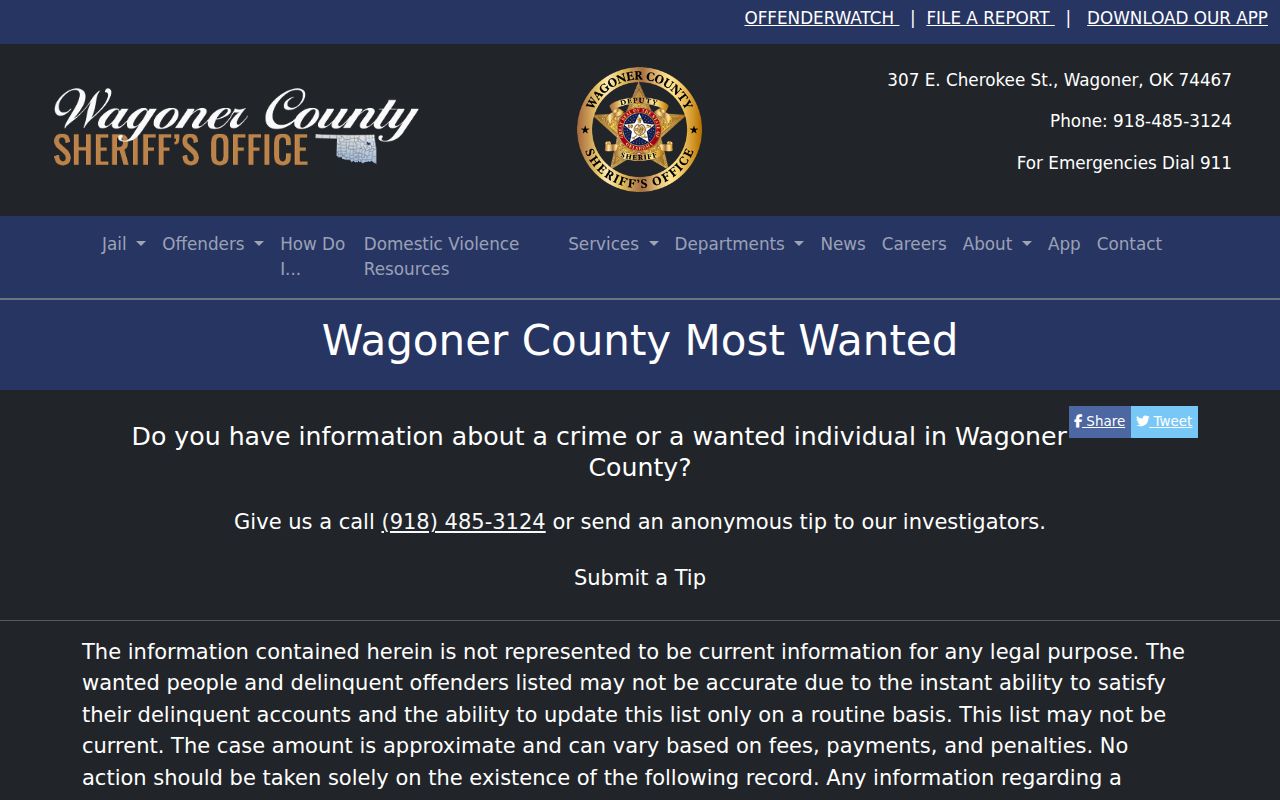
The official view shows the page heading, how tips are routed, and the notice that status information may lag. Nothing on the face of the page settles whether a warrant is live or whether anyone is in custody.
Note: WCSO describes the list as subject to routine updates, so confirm an active status with the sheriff, clerk, or issuing court.
Wagoner Wanted Listing Fields
A filled-out WCSO wanted entry is an identification aid. It is not a case file. Expect fields like a photograph or image label, a physical description, an approximate bond amount, an area linked to the person, aliases, and a short wanted-for summary. Any single field can be blank. Bond figures can shift as fees, payments, or penalties change. The listing gives you clues. Officials hold the rest.
| Listing field | What it indicates |
|---|---|
| Photo or image label | An image may appear when WCSO has populated the listing. It is not a universal or permanent feature. |
| Race, sex, eye color, and hair color | Basic physical-description fields that may help the agency evaluate a tip, but do not establish identity by themselves. |
| Bond amount | An approximate amount shown on the list, which can change and should not be treated as a final court result. |
| Last known location and aliases | Context for the listing, not a direction to search for, contact, or follow a person. |
| Wanted-for text | The listed basis for the wanted notice. Court records provide the more complete process and disposition trail. |
Names get shared. Descriptions go stale. An online entry can change before the public page catches up, so WCSO, the issuing court, and the clerk remain the only reliable confirmers. Take the narrow reading: use just enough detail to make a good-faith tip, then leave identification and enforcement to the people trained for it.
Reading Wagoner County Wanted Listings
Begin at WCSO's own page. There the update notice travels with the information. The agency publishes no reward amount and no fixed posting schedule for wanted entries. There is no promise that every wanted person shows up publicly. Jot down a useful detail if you need one, like the name and the date you saw the listing. Then skip any conclusions about guilt, location, or current status. When nothing urgent is happening, the court and sheriff confirmation routes covered below are the right next step.
- Open the official WCSO most-wanted page and read its status warning before relying on any field.
- Compare only the listed identifiers needed to provide a tip. Do not try to verify identity in person.
- Record the date of the listing and, if relevant, the listed case or warrant wording for the agency or court.
- Use WCSO’s tip options for information about a person or crime. An emergency or crime in progress belongs with 911.
- For a legal-status question involving a specific person, use the clerk-led warrant check instead of assuming the public list is complete.
Safety notice. Never approach, follow, detain, or confront someone because of a wanted-list entry, and call 911 for any emergency or immediate threat.
Wagoner County Wanted Tips
WCSO provides a dedicated online tip form. It accepts anonymous submissions or a request for contact. Use it for information that could help investigators. It is not a channel for disputing a warrant or checking on someone's custody status. The agency also publishes a tip hotline plus an all-hours non-emergency number. No reward policy or amount appears in its public materials. Assume none exists.
Wagoner County Sheriff’s Office
Anonymous or contact-request tip: Submit a tip to WCSO
Tip hotline: 918-485-7799
Urgent non-emergency line: 918-485-3124
Emergency or crime in progress: 911
Share only what you actually know. A name, a date, a location the agency already knows about, or a relevant case detail all work. Guesses do not. And never post someone's personal details online while trying to match a listing.
Checking Wagoner County Warrants
Wagoner County has no standalone public warrant portal. Start with the Wagoner County Court Clerk, which links out to OSCN and ODCR. A name or case search there can surface docket entries tied to warrant issuance, a return, a recall, a failure to appear, or the eventual case disposition. Helpful context, yes. But dockets are not a same-hour answer on whether a warrant is still live, so WCSO, the clerk, or the issuing court has to make that call.
- Gather the correct full name and any case number. Similar names require extra care.
- Use the Court Clerk links to search OSCN or ODCR by name, county, court, or case number where the interface permits.
- Read the docket date and wording for issuance, return, recall, failure to appear, or disposition rather than relying on a search-result label.
- Call WCSO at 918-485-3124, the clerk, or the issuing court to confirm whether a warrant is active before acting on the information.
- If a person believes there is an identity or warrant error, contact an attorney or the issuing court for a safe, lawful resolution.
Warrant records belong to the court process. Entries get recalled or resolved. A docket updates on its own timetable rather than the sheriff's. Anyone handling a personal case should go through counsel or the court directly instead of working off a public listing.
Note: A clerk docket can show warrant history, but the sheriff or issuing court is the source for current active-status confirmation.
Wagoner Warrant Types
WCSO does not publish a countywide tally or category breakdown for its active warrants. The labels below are common ways court records describe warrants. They are not a claim that any Wagoner case fits a specific type. Read the actual docket. Ask the issuing court what the warrant means for that case.
| Warrant category | Court-process meaning |
|---|---|
| Arrest warrant | A court-authorized warrant connected with an alleged offense or filed case. Its current status requires confirmation. |
| Bench warrant | A warrant issued by a court, commonly associated with a failure to appear or noncompliance in a pending matter. |
| Failure-to-appear entry | A docket event indicating a missed required appearance. It may lead to a warrant or other court action depending on the case. |
| Recall or return | A later docket event that can reflect action on a warrant. It must be read with the date and confirmed by the court or WCSO. |
"Disposition" is the legal term for how a case ends. It could be a dismissal, a plea, a judgment, or some other court resolution. Booking text and wanted notices sit at the front of a case. The disposition is the record worth tracking before any conclusions are drawn.
Wagoner Wanted Status and Custody
Four records can carry one name and answer different questions. The WCSO wanted list is a public-safety list the agency chooses to publish. A court docket tracks case events, including possible warrant activity. The WCSO inmate search shows who sits in county custody now. The released view only covers people removed from custody within its published 72-hour window. Each system serves a different function and updates on its own schedule. So a name can appear in one and miss the rest.
A gap in the current roster has several explanations. The person may have been released, transferred, booked under a different name, or never booked into WCSO custody at all. A recent-release entry vanishes after 72 hours. It is not a permanent archive. For the legal timeline, go to the court record. The roster only shows a custody snapshot. Someone serving a state sentence sits in the separate Oklahoma Department of Corrections system, not on the wanted list. Match each source to its stated time frame.
WCSO App, VINE, OffenderWatch
The official WCSO mobile app adds another way to browse wanted persons with photos and descriptions. It also carries inmate information, booking details, recent arrests, community alerts, tips, news, and contacts. Download it from Google Play or the Apple App Store. WCSO posts no update schedule, retention period, or photo policy for the app. Do not lean on it as a permanent warrant archive.
Oklahoma VINE does a different job. It handles custody-status searches and notifications where available. It is not a public booking-photo archive. OffenderWatch is a sex-offender registry and alert service, separate from any booking roster or warrant database. Keeping the three systems straight prevents a common mistake. It stops you from reading an alert, registry entry, or wanted listing as a confirmed new arrest.
Note: The WCSO app, VINE, and OffenderWatch are separate services with different records, update practices, and public-display limits.